Essential Spanish for Appliance Repair
Learning a few key Spanish phrases can significantly improve your communication with customers, leading to increased customer satisfaction and potential business growth. In this guide, we’ll cover essential Spanish for appliance repair technicians to help you communicate effectively with Spanish-speaking customers in service calls, diagnostics, and troubleshooting situations.
Whether you’re working on washers, dryers, refrigerators, dishwashers, or ovens, knowing basic technical Spanish can improve customer trust, reduce misunderstandings, and make field service work smoother and more professional.
Enhance your communication with Spanish-speaking clients:
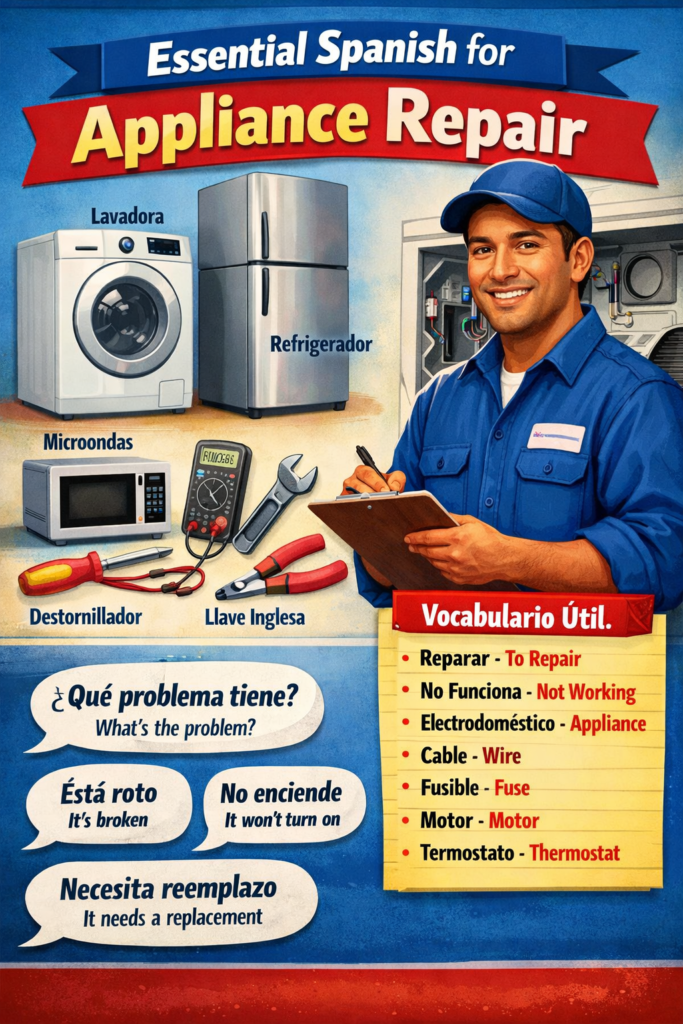
Essential Appliance Names
- Refrigerator: Refrigerador / Nevera
- Range: Estufa / Cocina
- Oven: Horno
- Cooktop: Quemadores / Placa de cocina
- Microwave: Microondas
- Washer: Lavadora
- Dryer: Secadora
- Dishwasher: Lavavajillas / Lavaplatos
Helpful Phrases
Introductions and Greetings
- Hello, I’m here to repair your appliance. Hola, vengo a reparar su electrodoméstico.
- Good morning/afternoon/evening. Buenos días/tardes/noches.
- How can I help you today? ¿En qué puedo ayudarle hoy?
Asking About the Problem
- What seems to be the problem with your [appliance name]? ¿Cuál parece ser el problema con su [nombre del electrodoméstico]?
- When did you first notice the issue? ¿Cuándo notó el problema por primera vez?
- Has this happened before? ¿Ha ocurrido esto antes?
- Is there anything specific I should know? ¿Hay algo específico que deba saber?
During the Repair
- I’ll need to take a look at the [part]. Necesitaré echar un vistazo al [pieza].
- I’ll need to order a replacement part. Necesitaré pedir una pieza de repuesto.
- I’ll need to test the [part] to see if it’s working properly. Necesitaré probar la [pieza] para ver si funciona correctamente.
- I’ll need to clean the [part] to remove any debris. Necesitaré limpiar la [pieza] para eliminar cualquier residuo.
- I’ll need to adjust the [setting] to fix the problem. Necesitaré ajustar la [configuración] para solucionar el problema.
Explaining the Issue
- The problem seems to be with the [part]. El problema parece estar en la [pieza].
- The [part] is damaged and needs to be replaced. La [pieza] está dañada y necesita ser reemplazada.
- The [part] is not working properly. La [pieza] no está funcionando correctamente.
Providing Updates
- I’m making good progress on the repair. Estoy haciendo buen progreso en la reparación.
- The repair will take approximately [time]. La reparación tomará aproximadamente [tiempo].
- I’ll let you know as soon as I have more information. Le informaré tan pronto como tenga más información.
Completing the Repair
- I’ve finished the repair. He terminado la reparación.
- Please test the [appliance] to make sure it’s working properly. Por favor, pruebe el [electrodoméstico] para asegurarse de que funciona correctamente.
- If you have any questions, please don’t hesitate to ask. Si tiene alguna pregunta, no dude en preguntar.
Additional Tips:
- Be patient and understanding.
- Speak clearly and slowly.
- Use simple language.
- Avoid using technical jargon.
- Be polite and respectful.
- Smile and make eye contact.
- Show appreciation for their business.
Final Thought
Learning essential Spanish for appliance repair helps technicians communicate clearly during service calls, explain technical issues confidently, and provide better customer support. Even basic phrases related to diagnosis, parts, and common faults can significantly improve efficiency and professionalism in the field.
I am a master appliance repair technician with over 35 years of experience in the field. I am passionate about helping people troubleshoot their appliances and fix common problems. My website, appliancemode.com, provides a wealth of information on troubleshooting common appliance issues and deciphering error codes. This website aims to empower people to tackle appliance repairs themselves and save money on service calls.