
Refrigeration Compressor Nameplate: How to Determine Horsepower and Cooling Capacity
As a master technician, when diagnosing a refrigeration or air-conditioning system, one of the situations I eventually encounter is a bad compressor. Once I determine that the compressor needs to be replaced, the nameplate becomes especially important because I need to identify the compressor correctly before selecting a replacement.
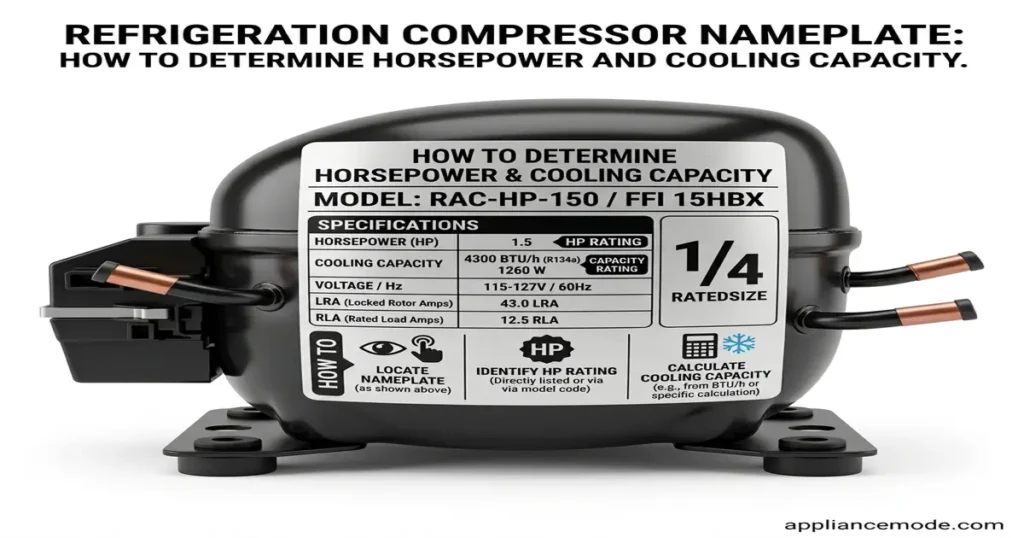
The nameplate can provide the information needed to identify the compressor, verify its intended application, confirm the refrigerant, and research its technical specifications.
One of the first challenges is that compressor nameplates rarely state something as straightforward as “1/4 HP” or “5,000 BTU/hr.” Instead, manufacturers use model numbers, electrical ratings, refrigerant information, displacement, and other technical codes.
A Master Technician’s Guide to Identifying Compressor HP, Capacity, and Application
To determine the compressor’s nominal horsepower, cooling capacity, and intended application, we need to decode this information and then cross-reference the exact model with the manufacturer’s technical data. Horsepower should be treated as a nominal reference rather than a value that can simply be calculated from the nameplate.
This guide explains the process I use to identify an unknown compressor and determine its nominal HP, refrigeration capacity, and intended application without relying on guesswork.
1. Start With the Compressor Nameplate
Before estimating anything, record everything visible on the nameplate. Typical information may include:
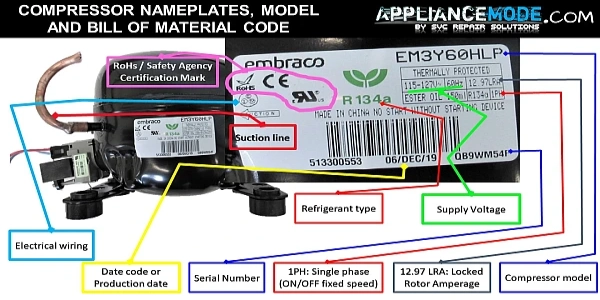
- Manufacturer
- Compressor model number
- Voltage
- Frequency
- Phase
- Refrigerant
- Rated current
- LRA (Locked Rotor Amps)
- Displacement
- Oil type
- Oil charge
- Electrical protection information
- Application or temperature range
- Serial number
- Production code
For example, a nameplate might identify a compressor as
Brand: Embraco
Model: EM3Y60HLP
Voltage: 115–127 V
Frequency: 60 Hz
Refrigerant: R134a
The most important item for identifying the compressor’s actual performance is usually the exact model number.
2. Why Compressor Horsepower Is Often Missing
A refrigeration compressor is not normally selected simply by motor horsepower. This is where many technicians, and especially inexperienced parts sellers, make mistakes.
An electric motor’s horsepower describes its mechanical power output. A refrigeration compressor, however, is normally evaluated according to its cooling capacity under defined operating conditions. Cooling capacity may be expressed as
- BTU/hr
- W
- kcal/hr
The same nominal motor horsepower can produce different cooling capacities depending on:
- Refrigerant
- Evaporating temperature
- Condensing temperature
- Suction temperature
- Discharge conditions
- Compressor efficiency
- Compressor design
- Operating frequency
- Application range
Therefore:
Do not assume that every 1/4 HP compressor has the same cooling capacity.
A 1/4 HP compressor from one manufacturer may have substantially different performance from another 1/4 HP compressor operating under different conditions.
3. The Model Number Is the Key
When I have an unidentified compressor on my workbench, my first priority is to obtain the complete model number from the nameplate. Do not record only part of the code.
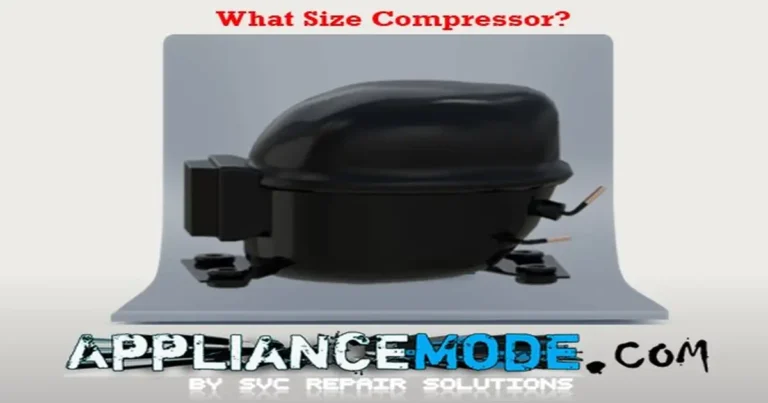
For example, the second compressor shown here is identified as FFI 12HBX. Recording only FFI would not be enough to identify the exact compressor.
The same principle applies to the Secop NF10FX compressor shown above. The complete designation is NF10FX; there is no space between the characters. Recording only NF10 or NF could lead to the wrong compressor being identified.
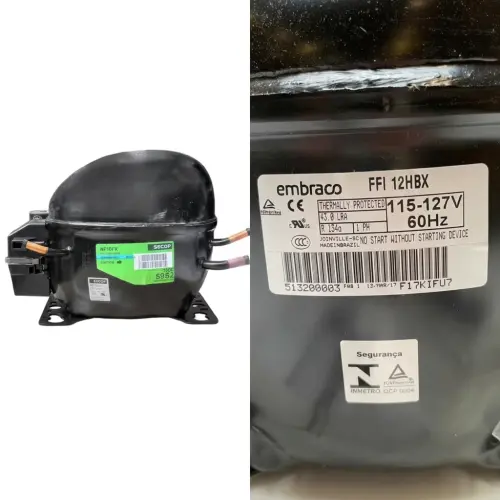
These examples show why every letter and number on the model designation matters. Individual characters can distinguish between different compressor families, refrigerants, application ranges, electrical configurations, or other technical specifications.
Technician’s rule
Never order a replacement compressor from a partially readable model number if the missing characters could identify a different model.
Clean the nameplate carefully and photograph it before attempting to interpret the code.
4. Identify the Manufacturer
Once the model number is recorded, identify the compressor manufacturer.
Common manufacturers include:
- Embraco
- Secop
- Danfoss
- Tecumseh
- Copeland
- LG
- Samsung
- Panasonic
- ACC
- Jiaxipera
The manufacturer’s technical documentation is usually the best source for determining the compressor’s actual performance.
Third-party compressor databases can be useful, but when available, I prefer to verify the information against the manufacturer’s own technical documentation.
5. Find the Compressor’s Technical Data
Search the manufacturer’s documentation using the exact model number.
You are looking for a technical data sheet, compressor catalog, selection software, or performance table.
The document may provide information such as
| Specification | Example |
|---|---|
| Model | Compressor model |
| Refrigerant | R134a |
| Displacement | cm³ |
| Application | LBP/MBP/HBP |
| Voltage | 220-240 V / 110-120 V |
| Frequency | 50-60 Hz |
| Cooling capacity | W or BTU/hr |
| Power consumption | W |
| COP | – |
| Oil type | POE/Mineral |
| Motor type | RSIR/CSIR/CSR/etc. |
This information is much more useful than trying to guess horsepower from the current rating.
6. Understand Displacement
Displacement is one of the important specifications used to characterize a compressor. It is commonly expressed in cm³/rev or another manufacturer’s specified displacement unit. Displacement tells us how much refrigerant volume the compressor theoretically moves during operation.
In general, a larger displacement compressor can move more refrigerant than a smaller compressor of the same basic design. However, displacement does not directly equal cooling capacity. This is an important distinction. Two compressors with similar displacement can have different refrigeration capacities because of differences in:
- Compressor efficiency
- Valve design
- Motor efficiency
- Refrigerant
- Operating speed
- Compression ratio
- Application range
- Operating conditions
Therefore, use displacement as an identification and comparison parameter, not as a direct BTU/hr calculation.
7. Determine the Application Range
Before looking at capacity, determine what the compressor was designed to do. You may encounter terms such as
LBP/Low Back Pressure
Typically associated with applications requiring relatively low evaporating temperatures, such as
- Freezers
- Low-temperature refrigeration
- Some deep-freezing applications
MBP/Medium Back Pressure
Common in applications such as
- Refrigerators
- Refrigerated cabinets
- Medium-temperature refrigeration
HBP/High Back Pressure
Often associated with higher evaporating-temperature applications such as:
- Beverage coolers
- Some commercial refrigeration systems
- Certain air-conditioning applications
The exact application depends on the manufacturer’s classification.
Important
The same compressor cannot be assumed to have one universal cooling capacity.
Its rated capacity depends on the operating conditions used for the performance test.
8. Read the Performance Table
For example, FFI12HBX1. This is where the real capacity information is found.
A manufacturer’s performance table may show something similar to
| Evaporating Temperature | Cooling Capacity |
|---|---|
| -22°F | 241 W |
| -10°F | 292 W |
| 5°F | 372 W |
| 14°F | 421 W |
| 32°F | 527 W |
As evaporating conditions change, compressor capacity changes.
This is why saying
“This is a 1/3 HP compressor; therefore, it is exactly High Temp (HT) at 45°F.” ~1,190 BTU/h
is not technically reliable. The correct approach is
Identify compressor → identify refrigerant → identify application → identify operating conditions → read manufacturer performance data.
9. Convert Watts to BTU/hr
If the manufacturer’s capacity is given in watts, you can convert it to BTU/hr.
The approximate conversion is
1 W = 3.414 BTU/hr
Therefore: Cooling Capacity (BTU/hr) = Cooling Capacity (W) × 3.412
For example, if a compressor is rated at 527 W, then:
527 × 3.414 ≈ 1,706 BTU/hr
This conversion is useful when comparing specifications from different manufacturers.
10. What Does Compressor “HP” Actually Tell You?
Horsepower is commonly used in the refrigeration industry as a convenient nominal compressor size designation.
You may see compressors described as:
- 1/10 HP
- 1/8 HP
- 1/6 HP
- 1/5 HP
- 1/4 HP
- 1/3 HP
- 1/2 HP
- 3/4 HP
- 1 HP
But these numbers should be treated carefully. A nominal 1/4 HP designation does not automatically tell you the compressor’s exact refrigeration capacity. For replacement purposes, I would never select a compressor based on HP alone.
Instead, compare:
- Application range
- Cooling capacity
- Displacement
- Voltage
- Frequency
- Phase
11. Why Amperage Is Not a Reliable HP Calculator
Another common field mistake is attempting to determine compressor horsepower from running current.
For example:
“The compressor draws 2 amps, so it must be a 1/4 HP compressor.”
That conclusion is unreliable.
Compressor current can change significantly depending on:
- Supply voltage
- Refrigerant
- Suction pressure
- Discharge pressure
- Ambient temperature
- Condenser condition
- Evaporator load
- Compressor temperature
- Electrical design
- Starting method
LRA is also not the same thing as running current.
LRA: Locked Rotor Amps
LRA represents the approximate current associated with the motor under locked-rotor conditions.
RLA/FLA
Depending on the manufacturer and documentation, running or rated-load current specifications may be expressed differently.
These electrical values are important for diagnosing electrical problems and selecting components, but they should not be used alone to determine refrigeration capacity.
12. Refrigerant Matters
Never separate compressor identification from refrigerant identification. A compressor designed for R134a, should not automatically be treated as equivalent to a compressor designed for R600a, R404A, or R290. Different refrigerants have different thermodynamic properties and require different compressor designs and operating conditions.
Always verify:
- Refrigerant
- Application
- Pressure range
before installing a replacement.
13. Don’t Confuse Motor Power With Cooling Capacity
This distinction is fundamental.
- Electrical/motor power tells you about the power consumed or delivered by the compressor motor.
- Cooling capacity tells you how much heat the refrigeration system can remove under specified conditions.
They are related, but they are not the same measurement.
For example, two compressors may consume similar electrical power while producing different Cooling capacities because their efficiencies and operating conditions differ.
This is why compressor selection should be based primarily on the required cooling duty and manufacturer’s performance data, rather than simply matching motor horsepower.
14. A Practical Compressor Identification Procedure
When replacing an unknown compressor, I use the following workflow.
Step 1 — Photograph the Nameplate
Take a clear photograph before removing the compressor.
Make sure the following can be read:
- Brand
- Model
- Refrigerant
- Voltage
- Frequency
- Current
- Serial information
Step 2: Write Down the Complete Model
Do not rely on memory. Record every letter and number.
Step 3: Identify the Refrigerant
Confirm the refrigerant shown on the compressor and compare it with the system specification.
Step 4: Identify the Application
Determine whether the compressor is intended for:
- LBP
- MBP
- HBP
- Air conditioning
- Commercial refrigeration
- Household refrigeration
Step 5: Locate the Manufacturer Data
Find the official technical documentation for the exact model.
Step 6: Record the Displacement
Use displacement as another way to verify that you have identified the correct compressor.
Step 7: Check the Performance Data
Find the cooling capacity at the appropriate evaporating and condensing conditions.
Step 8:Convert Units if Necessary
Convert: W → BTU/hr
using: BTU/hr ≈ W × 3.412
Step 9 — Compare the Replacement
Do not compare HP alone also compare the complete technical specification.
15. Example of a Technician’s Identification Process
Suppose you encounter a refrigerator with a compressor carrying a nameplate showing:
Model: [exact model number]
Refrigerant: R600a
Voltage: 110–120 V
Frequency: 50 Hz
The correct procedure is not to immediately say:
“This looks like a 1/5 HP compressor.”
Instead:
- First: identify the exact compressor model.
- Second: locate the manufacturer’s technical data.
- Third: verify the refrigerant and application range.
- Fourth: locate the performance table.
- Fifth: find the cooling capacity at the operating conditions relevant to the refrigerator.
- Finally: compare that information with the proposed replacement compressor.
This process eliminates much of the guesswork involved in compressor replacement.
16. Information You Should Record Before Ordering a Replacement
Before purchasing a replacement compressor, record the following:
Compressor Identification
- Manufacturer
- Complete model number
- Serial number if necessary
Electrical
- Voltage
- Frequency
- Phase
- Starting method
- Running current
- LRA
Refrigeration
- Refrigerant
- Application range
- Cooling capacity
- Evaporating temperature
- Condensing temperature
- Displacement
Mechanical
- Mounting dimensions
- Suction connection
- Discharge connection
- Process/service tube
- Compressor dimensions
Lubrication
- Oil type
- Oil quantity
A compressor that physically fits the system is not necessarily a correct replacement.
17. The Most Common Mistakes
Mistake 1: Choosing by HP Alone
Wrong approach:
“Original compressor is 1/4 HP, so any 1/4 HP compressor will work.”
Better approach:
Match the complete application and performance requirements.
Mistake 2: Choosing by Amperage
Current alone cannot accurately determine refrigeration capacity.
Mistake 3: Ignoring Refrigerant
A compressor designed for one refrigerant should not automatically be substituted with another compressor simply because the electrical specifications look similar.
Mistake 4: Ignoring LBP/MBP/HBP
A compressor may have the correct nominal HP but the wrong application range.
Mistake 5: Ignoring Operating Conditions
Capacity must always be considered at defined operating conditions.
Mistake 6: Using Displacement as Capacity
Displacement is useful, but it is not a direct BTU/hr rating.
Mistake 7: Relying on a Generic Compressor Chart
Generic HP-to-BTU charts can be useful for rough reference, but they should not replace the manufacturer’s performance data when selecting a compressor.
18. Master Technician’s Rule
When identifying a compressor, remember this simple rule:
The model number identifies the compressor. The manufacturer’s performance data tells you what the compressor can actually do.
Horsepower is useful as a general reference, but it should not be the only specification used for compressor replacement. The safest identification process is:
Nameplate → Model Number → Refrigerant → Application → Performance Data → Capacity → Replacement Comparison
That is the method I recommend when you need to identify an unknown compressor accurately rather than simply making an educated guess.
Final Checklist
Before approving a compressor replacement, verify:
☐ Manufacturer
☐ Refrigerant
☐ Voltage
☐ Frequency
☐ Phase
☐ Application range
☐ Displacement
☐ Cooling capacity
☐ Operating conditions
☐ Motor/start configuration
☐ Oil type
☐ Mounting dimensions
☐ Suction/discharge connections
If these specifications match the system requirements, you have a much stronger basis for selecting the correct compressor than simply matching the advertised horsepower.
Remember: in refrigeration, HP is only part of the story. Capacity, refrigerant, application, and operating conditions determine whether a compressor is actually suitable for the job.

I am a master appliance repair technician with over 35 years of experience in the field. I am passionate about helping people troubleshoot their appliances and fix common problems. My website, appliancemode.com, provides a wealth of information on troubleshooting common appliance issues and deciphering error codes. This website aims to empower people to tackle appliance repairs themselves and save money on service calls.