

Front Load Washer Basics: How It Works, Parts & Maintenance
How Front-Loading Washing Machines Work, Installation, Components & Maintenance
Front-load washing machines are designed around a horizontal-axis drum that tumbles clothes through water rather than using a traditional top-load agitator. Understanding how a front-load washer fills, washes, rinses, drains, spins, and controls water levels is an important foundation for appliance repair and troubleshooting.
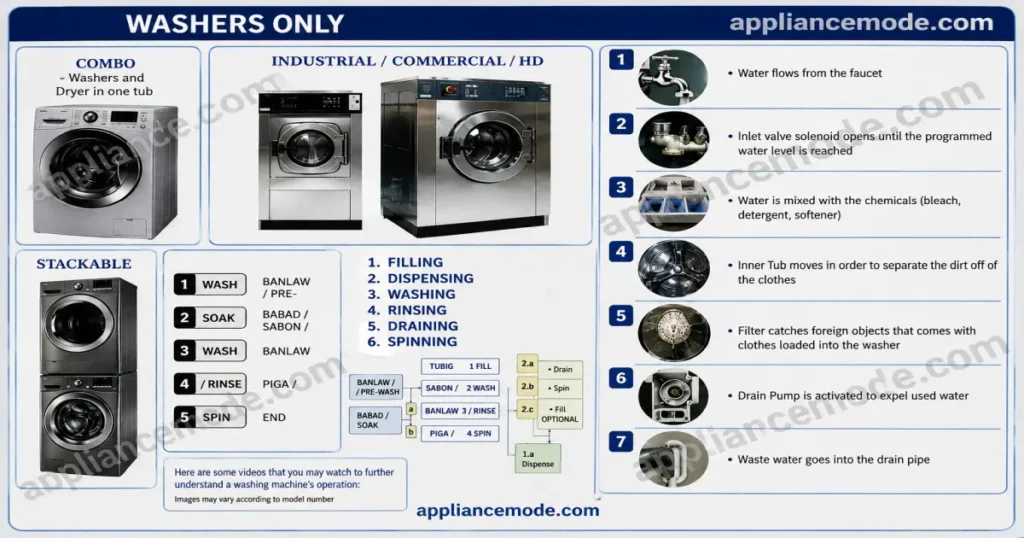
This guide explains the basic operation of front-load washers, installation requirements, detergent requirements, major components, drive systems, and recommended maintenance procedures.
What Is a Front Load Washer?
A front-load washer is a washing machine that loads clothes through a door located on the front of the appliance. Unlike traditional top-load washers with an agitator, front-load machines use a horizontally positioned drum with paddles on the side.
The drum rotates around its horizontal axis, lifting clothes and allowing them to fall back down through the wash water. This action is known as tumble washing.
How Tumble Washing Works
During a tumble-wash cycle:
- The drum rotates on its horizontal axis.
- Clothes are carried upward by the drum paddles.
- The clothes fall back down into the wash water.
- The repeated movement helps remove dirt from the load.
- Water heating can enhance dirt removal.
The training material also identifies several considerations associated with tumble washing, including the need for appropriate water flow, detergent requirements, potential tangling and wrinkling, and the larger size and weight of the machine.
How Does a Front Load Washer Work?
A front-load washer completes a series of controlled operations to clean and rinse clothing.
The main operating stages are Prewash → Wash → Rinse → Spin
The exact sequence can vary depending on the selected program and model.
1. Filling
The washer begins by allowing water to enter through the inlet valve. The valve opens according to the control system until the required water level is reached.
2. Dispensing
Water is combined with laundry chemicals such as detergent, bleach, or fabric softener according to the washer’s design and selected cycle.
3. Washing
The inner tub rotates to create the tumble action. The movement of the clothes through the water helps separate dirt from the load.
4. Rinsing
Fresh water is introduced to remove detergent and other residues from the clothes. The washer can repeat portions of the drain, fill, and spin sequence depending on the selected program.
5. Draining
The drain system removes used water from the washer. The drain pump is activated to expel wastewater from the appliance.
6. Spinning
During the final spin, the tub rotates at high speed to remove remaining water from the load before the cycle ends.
Front Load Washer Installation Requirements
Correct installation is important for proper washer operation and to minimize excessive noise and vibration.
The training material lists several pre-installation requirements for front-load washers.
Water Supply
The installation requires a faucet with a 3/4-inch thread.
For models equipped with a hot-water inlet, the water heater temperature is listed at 120°F (49°C).
Water Pressure
The specified operating water pressure is:
- Minimum: 10 PSI
- Maximum: 100 PSI
- Maximum temperature: 49°C for washers with a hot inlet valve
The specified water flow rate is 1 liter per 10 seconds or 1.5 liters per 15 seconds.
Drain Requirements
Drain-system requirements depend on the washer’s drain configuration. The training material specifies a maximum drain elevation of 10 cm and a maximum length of 3 meters for the listed drain system.
Leveling the Washer
A front-load washer should be properly leveled.
Correct leveling helps reduce excessive noise and vibration during operation. Adequate spacing around the machine is also important to reduce vibration-related noise and provide appropriate motor ventilation.
Remove the Shipping Bolts Before Operation
Front-load washers are transported with shipping bolts installed to secure internal components during transportation.
The installation procedure in the training material specifies:
- Unscrew the four transportation bolts using a spanner.
- Remove the bolts horizontally.
- Install the provided lids into the bolt holes.
Shipping hardware should therefore be addressed as part of the installation procedure before normal operation.
Why Use HE Detergent in a Front Load Washer?
Using the appropriate detergent is particularly important for low-water washing systems.
The training material explains that low-water washing can create excessive sudsing when regular, non-HE detergent is used.
Excessive suds can contribute to:
- Longer cycle times
- Reduced rinsing performance
- Potential component problems
- Mold or mildew buildup over time
HE Detergent
HE detergents are designed to produce an appropriate amount of suds for the washer’s operating conditions.
The training material lists the following detergent quantities:
- Powdered detergent: maximum 35 g
- Liquid detergent: maximum 45 mL
Always follow the detergent and appliance manufacturer’s instructions for the specific model.
Main Components of a Front Load Washer
Understanding the major components makes it easier to understand how a front-load washer operates.
The training material identifies several important components, including the control system, user interface, motor, drain pump, inlet valve, pressure switch, heater assembly, inner tub, outer tub, and balancer.
CCU – Central Control Unit
The CCU, referred to in the training material as the Domino Timer, serves as the control center of the washing machine.
It contains the different wash programs and settings used to control the appliance.
Door Switch
The door switch is activated when the washing cycle is about to begin.
It functions as a safety device during operation and helps prevent the machine from operating in an unsafe door condition.
Drive Motor
The drive motor provides the movement required to rotate the drum and create the tumble action.
The training material identifies the motor as the “heart” of the washer and describes belt-driven and other motor configurations.
Drain Pump
The drain pump is responsible for removing water from the washer.
In the described system, the electrically controlled drain system remains closed during washing and rinsing and opens during the drain/spin portion of operation.
Inlet Valve
The inlet valve allows water to enter the washing machine during washing and rinsing.
It can also be involved when the washer activates its foam-correction system.
Pressure Switch / Water-Level Sensor
The pressure switch is also known as the water-level sensor.
Its functions include measuring and validating the water level inside the washer and checking the amount of foam or suds produced during the wash cycle.
User Interface
The user interface is the PCB associated with the washer’s control panel. It provides the interface through which the user selects programs and settings.
Heater Assembly
The heater assembly includes the heater and NTC temperature sensor.
Direct Drive vs. Conventional Belt Drive
Front-load washers can use different drive-system designs.
The training material compares a conventional belt-drive system with a direct-drive system.
A conventional belt-drive arrangement includes components such as
- Motor
- Belt
- Pulley
- Outer tub
A direct-drive arrangement uses a motor connected more directly to the drum system and includes components such as the BLDC motor.
Direct Drive Motor Components
The material identifies components including
- Motor shield
- Motor stator
- Motor rotor
For the illustrated system, the Motor Control Unit (MCU) is part of the drive motor assembly. Another illustrated motor arrangement consists of a shield, stator, and motor and is connected directly to the CCU.
Because washer designs vary by model, technicians should always refer to the documentation for the specific appliance before diagnosing or replacing components.
Understanding the Washer’s Water-Level System
The water-level system is important because the washer needs to determine whether the appropriate amount of water has entered the tub.
The pressure switch, or water-level sensor, measures and validates the water level and can also monitor the amount of foam or suds generated during washing.
Problems involving water supply, pressure sensing, or excessive suds can therefore affect the washer’s normal operating sequence.
Model and Serial Number Location
The model and serial number are important when servicing a washing machine because technical information and replacement components can vary by model.
The training material shows separate model and serial-number locations for U.S. and non-U.S. machines, including washer-dryer combination models. It also warns that the UPC-12 code should not be mistaken for the serial number.
Before ordering parts or searching for technical documentation, verify the complete model number and serial number from the appliance identification label.
Front Load Washer Care and Maintenance
Regular maintenance helps keep the washer operating properly and can help prevent buildup and other problems.
Before the First Wash Cycle
Before the first normal wash, the training material recommends running a short wash program without a load to ensure the wash tub is clean from residual water associated with factory testing.
Cleaning the Exterior and Control Panel
The appliance exterior and control panel can be cleaned with:
- A soft, damp cloth
- A small amount of neutral, non-abrasive detergent
- A soft cloth for drying
Flammable liquids should not be used to clean the appliance.
Inspecting the Door Seal
The door seal should be checked periodically.
The training material recommends cleaning the seal with a bleach solution when necessary.
Cleaning the Washer Filter
The washer filter should be inspected and cleaned regularly.
The training material recommends cleaning the filter at least two or three times per year.
Front Load Washer Troubleshooting Basics
Understanding the washer’s operating sequence is the first step toward systematic troubleshooting.
When a washer does not operate correctly, technicians can think about the problem according to the operating stage:
Washer Does Not Fill
Check the components associated with water entry, including the water supply and inlet valve.
Washer Does Not Drain
The drain system and drain pump are key components involved in removing used water.
Washer Has Excessive Suds
Incorrect detergent or excessive detergent can contribute to excessive sudsing. HE detergent is designed for the low-water operation described in the training material.
Washer Vibrates Excessively
Proper installation and leveling are important for controlling vibration and operating noise.
Washer Does Not Tumble
The drive motor and associated drive system are responsible for creating the drum’s tumble movement.
These are basic diagnostic directions rather than model-specific repair procedures. Always use the service documentation for the exact washer model when performing electrical, mechanical, or component-level diagnosis.
Frequently Asked Questions
What is a front-load washing machine?
A front-load washing machine is a washer with a loading door on the front. It uses a horizontally oriented drum and paddles to tumble clothes through the wash water.
How does a front-load washer wash clothes?
The drum rotates on a horizontal axis, carrying clothes upward and allowing them to fall through the wash water. This repeated tumble action helps remove dirt.
What are the main stages of a front-load washer cycle?
The primary stages are filling, dispensing, washing, rinsing, draining, and spinning.
Why does a front-load washer need HE detergent?
Low-water washing can produce excessive suds when regular detergent is used. HE detergent is formulated to produce an appropriate amount of suds for this type of washing system.
What does the pressure switch do in a washing machine?
The pressure switch, also called the water-level sensor, measures and validates the water level and can check the amount of foam or suds produced during the wash cycle.
What does the drain pump do?
The drain pump removes used water from the washer during the drain portion of the cycle.
Why is leveling important for a front-load washer?
Proper leveling helps reduce excessive noise and vibration during operation.
How often should the washer filter be cleaned?
The training material recommends checking and cleaning the filter regularly, at least two or three times per year.
Why must shipping bolts be removed?
Shipping bolts secure components during transportation. The installation procedure requires removing the transportation bolts before normal operation.
Where can I find the washer’s model number?
The model-number location varies by model and region. The training material shows different identification-label locations for U.S., non-U.S., and washer-dryer combination models. Always verify the complete model number before looking for service information.
Final Thoughts
Understanding the fundamentals of a front-load washer provides a solid foundation for appliance maintenance and troubleshooting.
The basic operating sequence—fill, dispense, wash, rinse, drain, and spin—depends on several interconnected systems, including the inlet valve, pressure switch, control system, drive motor, heater, drain system, and user interface.
Proper installation, correct detergent selection, regular filter and door-seal maintenance, and accurate model identification are also important parts of servicing a front-load washing machine.
For model-specific diagnosis, wiring information, component testing, and repair procedures, technicians should consult the appropriate service documentation for the exact washer model.

I am an appliance repair technician with over 35 years of experience. I help people troubleshoot appliance problems, understand error codes, and fix common issues. On ApplianceMode.com, I share free guides and useful information to help people repair their appliances.