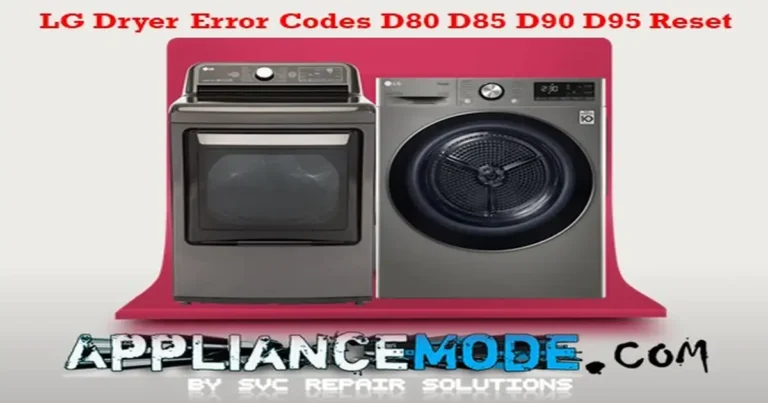

LG Dryer Error Codes Explained: What They Mean and How to Fix Them
When your LG dryer displays an error code, it is reporting a specific fault detected by its internal diagnostic system. These codes are designed to help identify issues quickly—ranging from airflow restrictions and heating system failures to sensor faults, motor problems, and communication errors.

Understanding LG dryer error codes can help you determine whether the issue is a simple maintenance fix or a component-level failure that requires technical repair.
Important Safety Notice
Before performing any inspection or repair:
- Always unplug the dryer from the power outlet
- Allow all components to cool completely
- Avoid touching electrical terminals or internal wiring unless qualified
- Use proper multimeter safety procedures when testing components
Many LG dryer systems operate with high voltage and can store electrical energy even after shutdown.
LG Dryer Error Codes Overview
Modern LG Electronics dryers use multiple sensors and control systems to monitor temperature, airflow, motor performance, moisture levels, and electronic communication between modules.
When a fault is detected, the dryer will stop operation and display an error code.
1. Thermistor & Heating System Errors
tE – Thermistor Error
Related Codes
tE1, tE2, tE3, tE4
Meaning
The dryer has detected an abnormal temperature reading in the heating system or drum airflow circuit.
Common Causes
- Faulty thermistor sensor
- Damaged wiring harness
- Failed heating element
- Faulty thermostat
Technical Note
This error indicates that the drum outlet temperature is outside the normal operating range.
Repair Steps
- Inspect thermistor wiring connections
- Test sensor resistance at room temperature
- Check heating element continuity
- Replace defective sensor or control board if necessary
tE1 – Thermistor 1 Error
- Heat pump models may indicate compressor outlet overheating
- Check thermistor and airflow system
tE2 – Thermistor 2 Error
- Drum temperature reading abnormal
- Inspect sensor and wiring
tE3 – Thermistor 3 Error
- Heating system temperature deviation
- Check thermistor circuit
tE4 – Thermistor 4 Error
- The error clears when load is removed and unit is reset
- Often load-related or temporary fault
2. Mechanical & Drum System Errors
bE – Belt Error
Meaning
The dryer detects that the drum cannot rotate properly.
Causes
- Broken or slipped drive belt
- Faulty belt switch
- Motor failure
Repair
- Inspect belt condition
- Test belt switch continuity
- Check motor operation
LE1 – Main Motor Restriction Error
Meaning
The drum motor is unable to rotate due to mechanical resistance or overload.
Causes
- Blocked airflow or mechanical obstruction
- Faulty motor
- Wiring harness issue
- Belt system failure
Repair
- Inspect drum rotation manually
- Check belt tension
- Test motor resistance
- Verify wiring integrity
3. Compressor & Heat Pump Errors
CE1 – Compressor Overheat Error
Meaning
The compressor is overheating or operating outside safe limits.
Causes
- High ambient temperature
- Faulty thermistor
- Compressor failure
- Airflow restriction
Repair
- Improve ventilation
- Test thermistor readings
- Inspect compressor operation
LE2 – Compressor Restriction Error
Meaning
The compressor cannot operate due to mechanical or airflow restriction.
Causes
- Blocked airflow
- High room temperature
- Compressor failure
4. Door & Heater System Errors
dE / dE4—Door Error
Meaning
The dryer detects that the door is open or not properly latched.
Causes
- Door not fully closed
- Faulty door switch
- Broken door lock mechanism
Repair
- Ensure door is fully closed
- Check switch continuity
- Inspect latch assembly
EHE – Electric Heater Error
Meaning
The heater circuit is drawing abnormal current or failing to heat properly.
Causes
- Faulty heating element
- Failed thermistor
5. Moisture, Drain & Water System Errors
OE – Drain / Water Error
Meaning
Water is not draining properly or is detected above safe levels.
Causes
- Blocked drain hose
- Full water tank
- Faulty drain pump
- Sensor failure
Repair
- Clean drain hose
- Empty water container
- Test drain pump motor
IES / E5 – Water Inlet Error
Meaning
Water supply issue in steam or water-fed models.
Causes
- Closed water valve
- Blocked inlet filter
- Frozen hose
- Faulty inlet valve
Repair
- Check water supply pressure
- Clean inlet filter
- Test inlet valve coil resistance
6. Sensor & Electronics Errors
Hs – Humidity Sensor Error
Meaning
The humidity sensor is not reading correctly.
Causes
- Sensor failure
- Wiring issue
nE / nF – Communication Errors
Meaning
Communication failure between display board and Wi-Fi/NFC modules.
Causes
- Faulty harness
- Defective module
- Display PCB failure
EE – EEPROM Error
Meaning
Control board memory failure.
7. Airflow & Duct Blockage Errors
Airflow restriction is one of the most common dryer issues.
d75 / d80 / d90 / d95 – Duct Blockage Alerts
Meaning
Dryer exhaust airflow is restricted:
- d75 → ~75% blocked
- d80 → ~80% blocked
- d90 → ~90% blocked
- d95 → ~95% blocked
Causes
- Lint buildup in vent
- Kinked exhaust hose
- Blocked external vent cap
Repair
- Clean full duct system
- Inspect external vent outlet
- Do not operate dryer until airflow is restored
8. Power & System Errors
PF/nP/P5: Power Interruption Error
Meaning
A power supply interruption occurred during operation.
Causes
- Power outage
- Loose power cord
- Tripped breaker
9. Gas Dryer Specific Error
9A5 – Gas Supply / Power Error
Meaning
Gas or power supply issue detected in gas dryer models.
Causes
- Incorrect wiring
- Gas valve closed
- Electrical supply failure
LG Dryer Electrical Component Reference (Technician Data)
Below are typical resistance values used in diagnostic testing:
- Temperature sensor: ~9.2 kΩ at 77°F (25°C)
- Compressor thermistor: ~282 kΩ at 25°C
- Belt switch: 0.1–2.1 Ω (closed), OL (open)
- Heating element: ~9.8 Ω per coil
- Motor switch: 0.1–2.1 Ω
Always ensure the dryer is unplugged before testing electrical components.
Expert Technician Insight
From a repair perspective, LG dryer failures typically fall into four major categories:
1. Airflow Restrictions (Most Common)
- Duct blockage
- Lint buildup
- Vent restriction
2. Heating System Failures
- Thermistor drift
- Heating element failure
- Relay faults
3. Mechanical Failures
- Belt breakage
- Motor failure
- Drum obstruction
4. Electronic Control Failures
- PCB failure
- Communication errors
- Sensor misreads
Correct diagnosis always begins with airflow and sensor testing before replacing major components.
Final Conclusion
LG dryer error codes provide a detailed diagnostic roadmap that helps identify faults quickly and accurately. By understanding what each code means—and how it relates to airflow, heating, sensors, and motor systems—you can significantly reduce repair time and avoid unnecessary part replacements.
For best results, always follow a structured diagnostic approach: airflow → sensors → mechanical → electronics.
I am an appliance repair technician with over 35 years of experience. I help people troubleshoot appliance problems, understand error codes, and fix common issues. On ApplianceMode.com, I share free guides and useful information to help people repair their appliances.