
LG Range Oven Error Codes Explained: Expert Troubleshooting Guide
When your LG range or wall oven displays an error code, it is alerting you to a specific system fault detected by the electronic control board. These fault codes are designed to help homeowners and technicians quickly identify problems related to temperature sensors, heating circuits, door lock mechanisms, cooling fans, communication systems, and other critical oven components.
Understanding what the LG range oven error codes mean can save valuable diagnostic time and help determine whether the issue is something simple, such as a loose connection, or a more serious component failure requiring replacement.
LG Range Oven Error Codes
Important Safety Warning
Before performing any inspection, troubleshooting, or repair:
- Disconnect power to the appliance at the circuit breaker.
- Allow all oven surfaces and heating elements to cool completely.
- Use proper electrical safety precautions when testing components.
- If you are not comfortable working with live electrical systems, contact a qualified appliance repair technician.
Many LG range error codes involve high-voltage circuits, heating elements, relays, and electronic control boards that can present electrical shock hazards if handled improperly.
How LG Range Oven Diagnostics Work
Modern LG ovens continuously monitor critical components through sensors and feedback circuits. When the main control board detects an abnormal condition, it stores a fault code and may disable heating functions to prevent damage or unsafe operation.
Commonly monitored components include:
- Oven temperature sensors (thermistors)
- Bake and broil heating elements
- Convection fan motors
- Cooling fans
- Door lock assemblies
- Meat probe sensors
- Communication circuit
Most LG range fault codes begin with the letter “F,” followed by a number that identifies the affected system.
LG Oven Temperature Sensor Error Codes
Temperature sensor failures are among the most common LG oven problems. The control board relies on accurate thermistor readings to regulate cooking temperatures. An open, shorted, or inaccurate sensor can trigger fault codes and prevent normal operation.
F1: Upper Oven Sensor Open
Fault Description
The main control board has detected an open circuit in the upper oven temperature sensor circuit and can no longer monitor oven temperature accurately.
Common Causes
- Failed upper oven thermistor
- Loose or disconnected sensor connector
- Damaged wiring harness
Technician Diagnosis
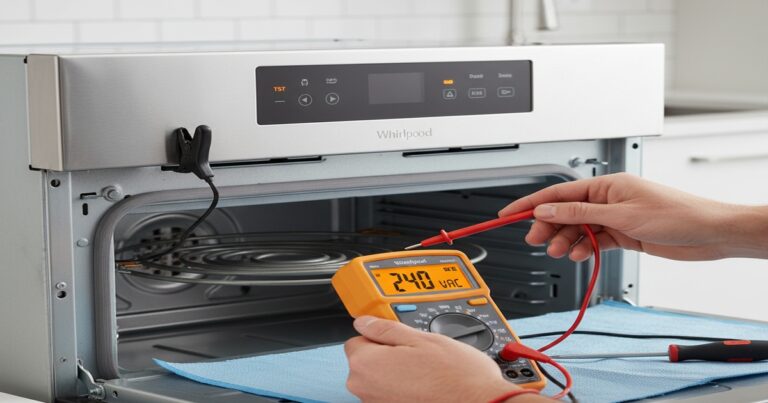
Measure sensor resistance at room temperature. Most LG oven temperature sensors should measure approximately 1,080–1,100 Ω at 77°F (25°C).
Recommended Repair
- Inspect wiring connections
- Test sensor resistance
- Repair damaged wiring
- Replace the sensor if readings are outside specifications
F2: Upper Oven Sensor Shorted
Fault Description
The control board detects a short circuit within the upper oven temperature sensor circuit.
Common Causes
- Shorted thermistor
- Pinched sensor wiring
- Moisture intrusion in connectors
Recommended Repair
Inspect wiring for damage and verify sensor resistance. Replace the sensor if resistance is significantly below specifications.
F4: Lower Oven Sensor Open
Fault Description
An open circuit has been detected in the lower oven temperature sensor circuit.
Possible Causes
- Failed lower oven thermistor
- Broken wire harness
- Poor connector contact
Recommended Repair
Inspect connections and verify sensor resistance before replacing components.
F5: Lower Oven Sensor Shorted
Fault Description
The lower oven temperature sensor circuit is shorted.
Common Causes
- Damaged thermistor
- Pinched harness
- Connector contamination
Recommended Repair
Inspect wiring and replace the sensor if resistance readings are outside factory specifications.
F8: Meat Probe Short Error
Fault Description
The oven has detected a short circuit in the meat probe circuit.
Common Causes
- Faulty meat probe
- Damaged probe wiring
- Defective probe receptacle
Recommended Repair
Inspect the probe and receptacle for damage and verify resistance values.
LG Oven Heating Error Codes
Heating-related fault codes occur when the control board detects abnormal temperature rise, overheating conditions, or a failure to heat.
F6: Upper Oven Overheat Condition
Fault Description
The upper oven temperature has exceeded safe operating limits.
Common Causes
- Failed temperature sensor
- Welded relay contacts
- Stuck bake or broil relay
Recommended Repair
Allow the oven to cool completely and test the temperature sensor and relay circuits.
F9: Upper Oven Not Heating
Fault Description
The oven failed to increase temperature during a heating cycle.
Common Causes
- Open bake element
- Failed broil element
- Defective relay
- Faulty sensor
- Wiring failure
Recommended Repair
Verify element continuity and check for proper voltage from the control board.
F16: Lower Oven Overheat Condition
Fault Description
The lower oven temperature exceeded safe operating limits.
Recommended Repair
Inspect the lower oven sensor, heating relays, and electronic control board.
F19: Lower Oven No Heat
Fault Description
The lower oven failed to reach the expected temperature during operation.
Common Causes
- Failed heating element
- Open wiring harness
- Defective sensor
Recommended Repair
Test heating elements, sensor resistance, and relay operation.
LG Oven Door Lock Error Codes
Door lock faults typically occur during self-clean cycles when the control board cannot verify proper lock operation.
F10: Upper Door Lock Failure
Common Causes
- Failed door lock motor
- Defective lock switches
- Wiring issues
Recommended Repair
Inspect the lock assembly and verify motor resistance and switch operation.
F20: Lower Door Lock Failure
Fault Description
The lower oven door lock system failed to operate correctly.
Recommended Repair
Inspect the lock motor, switches, wiring harness, and control board.
LG Communication Error Codes
F11: – Communication Failure
Fault Description
Communication between the main control board and one or more interface boards has been interrupted.
Common Causes
- Loose wiring harness
- Defective display board
- Failed cooktop control board
Recommended Repair
Inspect all communication connectors and verify continuity between boards.
LG Convection Fan Error Codes
F7: Upper Convection Fan Error
Fault Description
The upper convection fan failed to operate within expected parameters.
Common Causes
- Failed fan motor
- Damaged wiring
- Defective relay
Recommended Repair
Check motor resistance and inspect wiring connections.
F17: Lower Convection Fan Error
Fault Description
A malfunction has been detected in the lower convection fan circuit.
Recommended Repair
Test the fan motor, wiring harness, and control board output.
Advanced LG Range Oven Error Codes (F20–F69) Explained
This section covers advanced LG range oven and cooktop error codes related to door lock systems, steam sensors, induction circuits, IGBT modules, fans, and specialty cooking functions such as griddle and sous-vide.
These faults are typically more complex and often require electrical testing, control board diagnostics, and service manual reference.
F20: Lower Oven Door Lock Error
Error Description
The F20 error code indicates a failure in the lower oven door locking system. The control board is unable to confirm proper lock engagement or operation.
Possible Causes
- Faulty wiring harness
- Defective microswitches in the door lock assembly
- Failed door lock motor
- Faulty relay on control board
Recommended Troubleshooting
- Inspect the wiring harness connection at the main control board
- Test microswitch operation for continuity
- Check the door lock motor for mechanical or electrical failure
- Inspect relay operation on the control board
F21/F25: Steam Sensor Circuit Errors
Error Description
These error codes relate to steam system thermistor faults involving open or short circuits in temperature sensors.
- F21: Right steam sensor open circuit
- F22: Right steam sensor short circuit
- F24: Left steam sensor open circuit
- F25: Left steam sensor short circuit
Possible Causes
- Damaged or disconnected wire harness
- Faulty steam thermistor sensor
Recommended Troubleshooting
- Inspect steam sensor wiring harness connections
- Test sensor resistance with a multimeter
- Verify thermistor reading at room temperature (~25°C / 77°F ≈ 1.09 kΩ)
- Replace faulty sensor
F33/F34: Induction Hob Sensor Errors
Error Description
The F33 and F34 codes indicate faults in the induction cooktop temperature sensing system.
- F33: Front induction hob sensor error
- F34: Rear induction hob sensor error
Possible Causes
- Faulty thermistor sensor
- Damaged wiring harness
Recommended Troubleshooting
- Inspect wiring connections between hob and control board
- Test thermistor resistance (~1.09 kΩ at room temperature)
- Replace defective sensor
F36: IGBT Sensor Error
Error Description
The F36 error indicates a failure in the IGBT temperature monitoring circuit used in induction power control.
Possible Causes
- Faulty IGBT thermistor
- Damaged sensor harness
- Failed inverter board
Recommended Troubleshooting
- Inspect sensor wiring connections
- Test IGBT thermistor resistance
- Check inverter board functionality
F38: Induction Communication Error
Error Description
The F38 error occurs when communication between the induction cooktop and control system is interrupted.
Possible Causes
- Loose or damaged communication harness
- Faulty main control board
Recommended Troubleshooting
- Inspect all harness connections between boards
- Verify continuity and secure connections
F42: Induction Overvoltage Error
Error Description
The F42 error indicates excessive DC-link voltage detected in the inverter circuit.
Possible Causes
- Faulty induction inverter board
Recommended Troubleshooting
- Inspect inverter board for damage
- Check wiring harness integrity
F45: Box Fan Error
Error Description
The F45 error indicates a malfunction in the oven’s cooling or box fan system.
Possible Causes
- Faulty box fan motor
- Damaged wiring harness
- Faulty cooktop or control board
Recommended Troubleshooting
- Inspect fan motor operation
- Check wiring connections
- Test fan voltage supply
- Replace defective fan
F51/F52: Griddle Sensor Errors
Error Description
These codes relate to griddle temperature sensing faults.
- F51: Griddle sensor open circuit
- F52: Griddle sensor short circuit
Possible Causes
- Faulty griddle thermistor
- Wiring harness damage
Recommended Troubleshooting
- Inspect wiring connections
- Test sensor resistance (~1.09 kΩ at 25°C / 77°F)
- Replace sensor if readings are abnormal
F56: Griddle Overheat Error
Error Description
The F56 error occurs when the griddle temperature exceeds approximately 345°C (653°F) for an extended period during operation.
Possible Causes
- Faulty thermistor
- Stuck heating relay
Recommended Troubleshooting
- Allow appliance to cool completely
- Inspect temperature sensor accuracy
- Check relay switching operation
F59: Griddle Heating Failure
Error Description
The F59 error indicates the griddle failed to reach the expected temperature rise within the programmed time.
Possible Causes
- Failed igniter or heating element
- Faulty thermistor
- Wiring or relay failure
Recommended Troubleshooting
- Check igniter/heating element operation
- Test thermistor response
- Inspect relay output from control board
- Replace faulty components as needed
F62–F69: Sous-Vide System Errors
Error Description
These codes relate to sous-vide cooking system faults:
- F62: Sous-vide sensor short circuit
- F69: Sous-vide heating failure (no temperature rise)
Possible Causes
- Faulty sous-vide thermistor
- Damaged wiring harness
Recommended Troubleshooting
- Replace sensor or control board if readings are incorrect
- Disconnect power before inspection
- Check sensor wiring and connections
- Measure thermistor resistance (~1.09 kΩ at 25°C / 77°F)
General LG Oven Troubleshooting Tips
Before replacing components, perform these basic diagnostic checks:
- Reset power to the appliance by turning the breaker off for 5 minutes.
- Verify all wiring harness connections are secure.
- Inspect connectors for corrosion or heat damage.
- Test oven temperature sensors for proper resistance.
- Check heating elements for continuity.
- Review the technical data sheet for your exact model.
Final Thoughts
LG range oven error codes are valuable diagnostic tools that help identify specific component failures and operating problems. While some issues can be resolved through simple inspections or sensor replacement, others may require advanced electrical testing and professional diagnosis.

I am a master appliance repair technician with over 35 years of experience in the field. I am passionate about helping people troubleshoot their appliances and fix common problems. My website, appliancemode.com, provides a wealth of information on troubleshooting common appliance issues and deciphering error codes. This website aims to empower people to tackle appliance repairs themselves and save money on service calls.